If you have worked with equestrian products for a while, you will notice something very quickly:
fly masks and horse boots may not look complicated, but they are much easier to get wrong than many buyers expect.
A lot of people look at these products and think they are fairly straightforward. A few fabric panels, some binding, hook-and-loop closure, inner materials and basic structure. And that is exactly why quality risk is often underestimated.
To be honest, the biggest problem with these products is usually not that the sample cannot be made. It is that the sample looks fine, and the trouble only starts later in bulk production or actual use.
And once the problem shows up only after the product reaches the end customer, it usually stops being a small problem.
We have seen plenty of cases like this over the years.
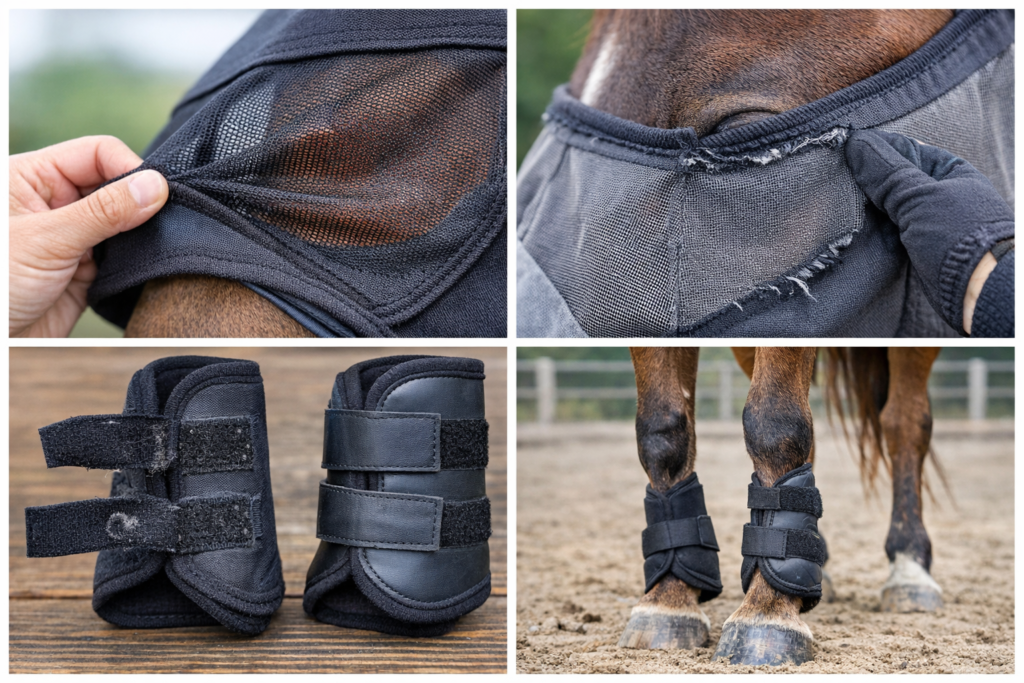
The sample looked fine. The photos looked fine. The buyer was happy at first. Then the bulk order arrived, and the issues started to show one by one: fly mask mesh that was too soft and sat too close to the eye area, unstable binding workmanship, horse boot fastening straps that lost reliability too quickly, poor symmetry, inner materials that looked acceptable but did not feel comfortable in real use.
None of these always look dramatic on their own.
But that is exactly the point. Small quality weaknesses, when they add up, are often what slowly damage customer experience and brand trust.
So in this article, I do not want to stay too general.
I would rather talk about the real issue: where quality problems usually appear in fly masks and horse boots, and what buyers should watch more carefully.
1. Fly Masks: the simpler they look, the easier it is to underestimate the details
A lot of buyers underestimate how sensitive fly masks are to detail control.
From the outside, they do not look like highly technical products. But in reality, fly masks are very detail-driven. Once the small details are not handled well, the end customer notices very quickly.
Mesh that is too soft or too stiff
This is extremely common.
Some fly masks use mesh that is too soft. On the table, the sample may still look acceptable. But once worn, the structure does not hold well enough, and the mesh can sit too close to the eye area. Comfort drops immediately.
On the other hand, some products go too far in the other direction and use mesh that is too stiff.
Yes, it may look more shaped and more structured at first glance. But in actual wear, it can reduce softness and make the overall fit feel less natural.
So no, fly mask mesh is not better just because it is stiffer, and it is not better just because it is softer.
What really matters is whether it creates the right balance between shape retention and comfort.
That sounds simple, but it is exactly where many products go wrong.
Binding and edge finishing often reveal the real workmanship level
This is one of the most overlooked parts.
A lot of buyers look first at the mesh, the colors, the ear fabric, maybe even the logo or overall styling.
But honestly, binding and edge finishing are often what make the product look either properly made or obviously weak.
If the binding is uneven, if the stitching line is not clean, if local wrinkling appears, the product loses quality impression immediately. And beyond appearance, poor edge finishing often leads to later issues such as:
loose stitching,
curled edges,
faster wear,
local deformation.
This may not always stand out in a sample because the quantity is small and the piece gets more attention.
But once production scales up, binding consistency becomes much more revealing.
I have always felt that fly masks are the kind of product that expose a factory’s detail control very quickly.
They look simple, but there is really nowhere to hide poor workmanship.
Hook-and-loop issues are more serious than many buyers think
This is another classic after-sales problem.
What keeps the fly mask in place? In many cases, the answer is simple: hook-and-loop closure.
If that part is weak, or if the placement and length are not well designed, problems start quickly:
weak grip,
fast loss of adhesion,
loose fit during wear,
inconsistent left-right fastening.
This may not sound dramatic, but it affects user confidence immediately.
The end customer may not analyze the product in technical terms. They just come to a simple conclusion: this product does not stay secure, so it does not feel reliable.
And a lot of products do not lose trust because of one major failure. They lose trust because the basic functional parts feel unstable.
Ear fabric and face-contact comfort are often checked too lightly
This is one area I believe many buyers judge too superficially.
A lot of people focus on whether the front mesh looks neat and whether the shape feels right. But the ear fabric and the face-contact areas often get far less attention.
In real use, those two areas matter a lot.
If the ear material has weak stretch, poor breathability or an unpleasant hand feel, customers will notice discomfort quickly. In warmer conditions, the problem becomes even more obvious.
This may sound like a minor issue, but it affects repeat business directly.
My own view has always been this:
with fly masks, the first impression may help sell the product, but comfort is what decides whether the customer will want to buy again.
Sizing and pattern inconsistency are among the hardest problems to explain away
This is especially frustrating for brands and wholesalers.
Fly masks are not flat products. Pattern shape, symmetry and ear placement matter more than many people think.
A sample may look fine, but once bulk production starts, size variation or visible asymmetry can directly affect fit.
And when that happens, there is not much room for explanation.
It is very hard to tell a customer that a product is “only slightly inconsistent” when the fit is clearly not right.
That is why pattern consistency in fly masks should never be treated as a small issue.
It looks small at first. In real business, it quickly turns into complaints and replacements.
2. Horse Boots: many of the worst problems do not appear immediately
Horse boots are usually more difficult to control than fly masks because they involve more than just materials. They involve structure, fastening systems, fit, support and repeated wear performance.
And here is what makes them tricky:
many of the biggest problems do not appear on day one. They start to show only after the product has been used for a while.
Those delayed problems are often the hardest ones to deal with.
Material strength that looks fine early, but disappoints later
This is very common in practice.
Some horse boots look acceptable in sampling. The shape is fine, the hand feel seems fine, nothing looks obviously wrong.
But once they enter daily use, material weakness starts to show:
surface wear too early,
structure losing firmness,
outer material fuzzing or breaking down,
support feeling weaker after repeated use.
What makes this frustrating is that it is not always an immediate failure.
The customer may even feel positive at first. Then a few weeks later the feedback changes: the quality does not feel stable, and the product does not feel worth the price.
That kind of problem damages trust much more deeply than a visible defect at arrival.
Fastening straps and hook-and-loop durability are one of the clearest weak points
I would strongly suggest every buyer pay close attention here.
A horse boot can look good, but if the fastening system is weak, the whole product loses credibility.
And in real business, this is exactly where many problems happen.
Typical examples include:
hook-and-loop grip fading too quickly,
fastening strap length not well balanced,
inconsistent strap placement,
loose seams or deformation after repeated use.
Customers may not care about the terminology you use to describe structure. But they care very much when the product stops feeling secure after only limited use.
At the end of the day, horse boots are not the kind of product where weak fastening feels like a cosmetic flaw.
It feels like a product-level weakness.
Poor inner comfort is often more damaging than outer appearance issues
This is a point I really want to stress.
Many buyers naturally focus on outer appearance, structure and visual support shape. Those things matter, of course.
But in actual use, inner comfort often has more influence on long-term customer opinion.
If the inner layer is not soft enough, not breathable enough or badly finished at the edges, customers will quickly notice:
stronger friction,
more heat buildup,
rougher edge pressure,
lower comfort during longer wear.
I have always felt that one of the most underestimated parts of horse boots is the inside.
But if we are being honest, that “less visible inside” is often what decides whether the customer feels good enough to buy again.
Structural support that works in samples but not consistently in bulk
Horse boots are not flat products, so structural consistency matters more.
Some samples hold their shape nicely and look very convincing. But in bulk production, once control weakens, the problems show up:
uneven left-right support,
unstable fit in wear,
deformation after use,
structure losing firmness faster than expected.
This is one of the classic “sample is fine, bulk is weaker” situations.
The issue is usually not whether the factory can make one good sample. The real issue is whether that same result can be repeated consistently at scale.
That is why horse boots should never be judged by one good-looking sample alone.
Symmetry and sizing are not minor details
Horse boots depend heavily on left-right consistency, length control, width balance and fastening placement.
Once these things drift, customers notice almost immediately.
And customers usually do not treat these problems as minor cosmetic flaws.
They tend to see them as signs that the product is not professional enough.
This matters even more for brand customers, because brands are not only judging whether a product is usable. They are also judging whether it looks like a mature, dependable product line.
Stitching and finish quality can lower the whole product tier
There is another category of issue that may not cause immediate functional failure, but still lowers perceived quality quickly. For example:
stitching lines that do not look straight,
untidy edge finishing,
local wrinkling,
bulky seam transitions,
weak coordination in color and final detail presentation.
Taken one by one, these may not sound dramatic.
But together, they make the product feel rougher, less refined and less worth the price.
For brands, that can be just as damaging as an obvious defect, because it weakens how the whole product line is presented.
3. Why so many of these issues do not show clearly in the sample stage
This is worth saying very directly, because many sourcing mistakes start here.
The sample is usually the most carefully handled piece
This is a very common industry reality.
In sampling, material selection, workmanship and detail correction often get much more attention.
So a good sample should never automatically be treated as proof that the bulk order will be equally stable.
A small quantity hides variation
One sample looking fine does not tell you what 500 or 1,000 units will look like.
The real challenge is never making one piece look good. It is making a large batch stay consistent.
Some problems only show up after repeated use
Things like:
fading hook-and-loop strength,
binding wear,
structural distortion,
loss of comfort,
changes after longer use.
You simply do not see these problems by looking at a sample for a few minutes on a table.
4. What I would check most carefully as a buyer
If I were buying fly masks and horse boots for a brand, a wholesale program or distribution, these are the points I would watch most closely.
For fly masks
Is the mesh supportive enough without becoming too stiff?
Is the binding neat and stable?
Is the hook-and-loop closure reliable?
Are the ear and face-contact areas actually comfortable?
Is the left-right structure symmetrical?
Is the sizing stable?
For horse boots
Are the outer materials durable enough?
Are the inner materials comfortable and breathable?
Are the fastening straps and hook-and-loop parts reliable?
Is left-right symmetry controlled properly?
Is the structural support consistent?
Is the stitching and final finishing clean?
Honestly, if these points are not checked properly up front, many later complaints are not surprising at all.
5. Conclusion
Fly masks and horse boots are both the kind of products that look simple, but actually reveal a lot about manufacturing fundamentals.
The real difficulty is not whether they can be made.
It is whether they can be made in a way that is:
comfortable,
stable,
durable,
consistent,
and commercially dependable over time.
In my view, the biggest danger is not always one dramatic failure. It is the accumulation of many small weaknesses.
Because that is exactly what slowly erodes customer experience and brand confidence.
So when judging quality in these products, it is not enough to ask whether the sample looks good.
The real question is whether the product can stand up in terms of:
material stability,
workmanship consistency,
comfort,
durability,
and repeatability in bulk production.
If those points are clear, later complaints, returns and communication costs usually become much easier to control.
If you are developing a fly mask or horse boot product line, it is far better to identify the key quality risks early than to discover them later through bulk issues and after-sales problems.
If you would like to discuss materials, workmanship, sample development or bulk production for these categories, feel free to contact the Carlson team.